


Your input will help us improve your experience.
Your input will help us improve your experience.You can close this popup to continue using the website or choose an option below to register in or log in.
Already have an account? Sign in
Sign up free to keep exploring.
We use Necessary cookies to make our website work. We’d also like to set optional Functional cookies to gather anonymous site visitation data and Advertising cookies to help us understand which content our visitors value the most. By enabling these cookies, you can help us provide a better website for you. These will be set only if you accept.More information about the cookies we use can be found here Cookies Policy
Thanks for visiting TopUniversities.com today! So that we can show you the most relevant information, please select the option that most closely relates to you.
Views
Same As It Ever Was: HBS’s Class of 2016
Save
Share
Share via
Share this Page12
Table of contents
Table of contents
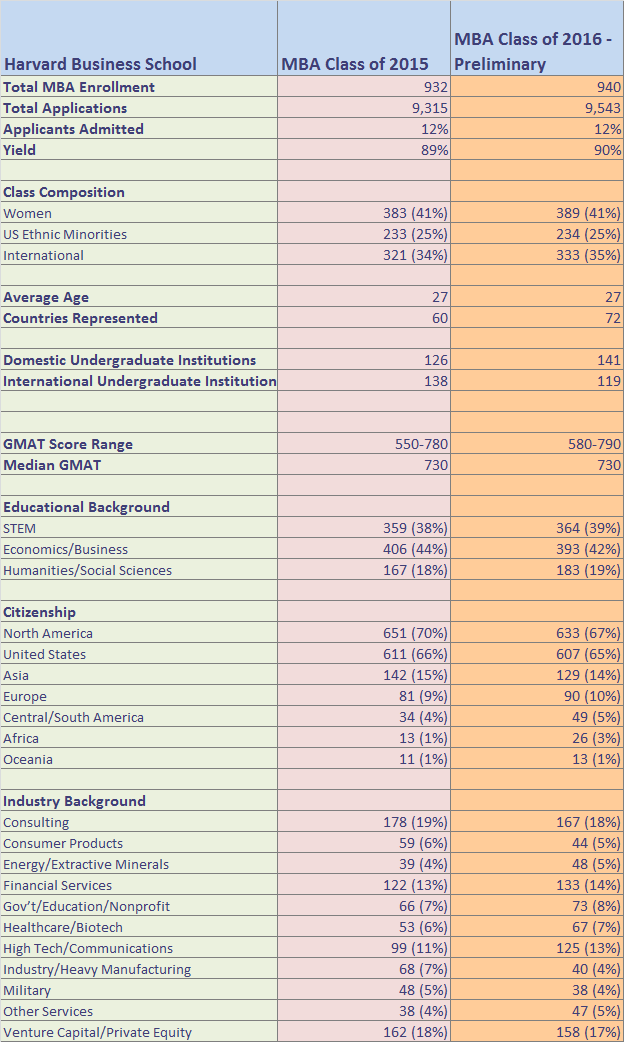
Here it is, hot off the presses folks: the Harvard Business School (HBS) Class of 2016 by the numbers. The first thing an astute observer will notice is that it’s not that much different from the Class of 2015. But there are a few tidbits worth noting.
For one, HBS enrolled fewer North American students, and more from other parts of the world—doubling the number of students from Africa in the Class of 2016. Consultants and finance types still represent the biggest chunk of the new class, but this year there were substantial increases in high-tech and energy.
It’s also just as difficult to get in as it ever was: only 12% of applicants (with median GMAT scores of 730) managed to pull it off. But, at least domestically, Harvard Business School seems to be casting a wider net, drawing its new class from 141 undergraduate institutions, up from 126. The Class of 2016 stats are preliminary and have not been officially released by HBS yet, but were obtained by TopMBA.com.
Recommended Articles Last year
MBA After BA: Should I Do an…
MBA programmes accept an array of undergraduate students. Read our QS guide on how to pursue an MBA with a non-business graduate degree.
MBA accreditation: everythin…
When looking for the right MBA programme, accreditation is an important consideration. It allows students to understand the way their qualification will be seen by employers and how it can be compared to other highly-regarded programmes.
Why you should choose an MBA…
Learn about why many leading business schools are incorporating sustainability into their curriculum, to ensure their graduates have the skills required to fully maximise their opportunities.